Who Is Accountable When Sign Language AI Gets It Wrong?

Reflecting on Mark Applin and Signly’s session about consent, ownership and Deaf-led accountability
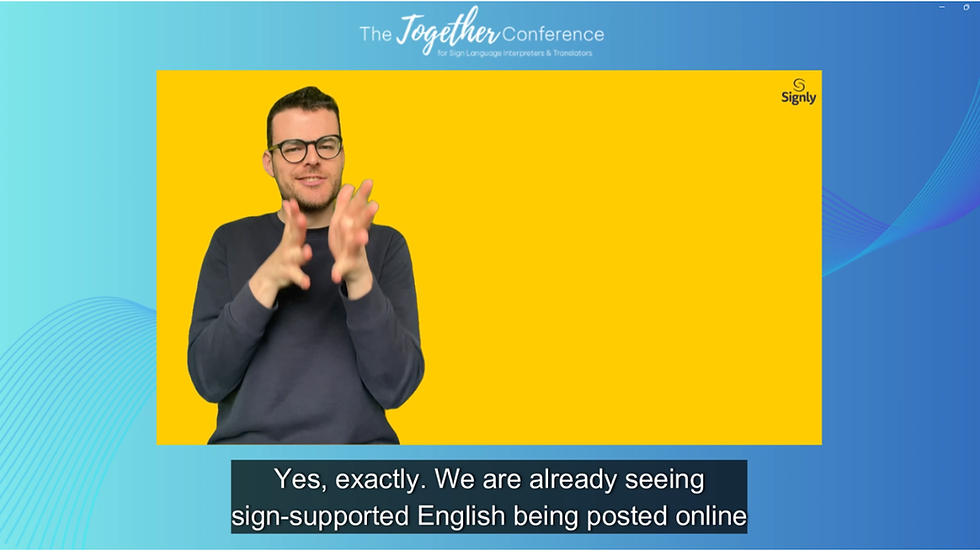
A man appears on screen and delivers a confident presentation about artificial intelligence, sign language and professional accountability.
He looks and sounds like Mark Applin. The audience has little reason to question whether it is really him.
Then, near the end of the presentation, the speaker reveals that he is not Mark at all. He is an avatar called Apps. His appearance and voice can be changed, and he can be made to say things that the real person never said.
Who would be responsible if that avatar misrepresented Mark, damaged somebody’s reputation or produced harmful information?
This final reveal brought the central question of Signly’s extended conference session into sharp focus.
Sign language AI is often presented as an exciting technological development that will increase access and make information available more quickly. Mark’s presentation did not argue that AI should be rejected. Signly is itself involved in developing AI.
Instead, the session asked what must be in place before the technology is trusted.
Who supplied the data? Did they give informed consent? Who owns the finished system? Who is paid when it is used? Who checks the language quality? What happens when something goes wrong?
Most importantly:
Who is accountable?
Sign language AI is already here
Discussions about artificial intelligence can make the subject sound like a future issue.
People may assume there is still time to decide what rules, protections and professional standards will be needed before AI becomes part of sign language work.
Mark’s session challenged that assumption.
AI systems are already using people’s voices, images, movements and creative work. Sign language professionals are already seeing generated signing shared online, sometimes accompanied by claims that the technology can provide language access cheaply and at scale.
The question is no longer whether sign language AI may affect interpreters, translators, teachers and Deaf communities one day.
The effects have begun.
This makes informed professional discussion urgent. Decisions about data, consent and ownership are being made now, often by companies or organisations whose work may not be visible to the people whose language is being used.
By the time a finished product appears, the training data may already have been collected, processed and built into a system that is difficult to reverse.
More noise than depth
The session began by acknowledging the amount of noise surrounding artificial intelligence.
Social media posts may describe a new system as revolutionary, inclusive or capable of solving an access problem. Short demonstrations show a digital person moving their hands, and viewers are encouraged to see the result as progress.
Much less attention may be given to the questions behind the demonstration.
Who created it?
What is their motivation?
What data was used?
What parts of the process are not being shown?
Is the output actually sign language, or does it only look convincing to an audience that does not know the difference?
Marketing works by simplifying a product’s story. Ethical scrutiny requires us to slow that story down again.
A company may describe its work as “technology for good”. That phrase does not tell us whether Deaf people hold decision-making power, whether contributors have continuing rights over their data or whether the system can be challenged when it causes harm.
Good intentions and positive language do not replace evidence.
A person’s signing is not just a collection of movements
Sign language AI may require data connected to a person’s name, image, likeness and signing style.
These are not neutral materials.
A person’s signing may reflect their identity, region, age, education, cultural background and relationship with the Deaf community. Their body and face carry linguistic information that cannot be separated neatly from who they are.
When recordings are used to train an AI model, the finished system may later produce new content based on patterns learned from that person’s contribution.
The original signer does not need to be present each time the system is used. The model can continue producing content at a scale no individual translator could match.
This creates a serious question about ownership.
A Deaf translator may be paid for one recording session, while the resulting data continues supporting a commercial product for years. The system may eventually be offered as an alternative to the same human professionals whose language, appearance or movement helped create it.
A one-off fee does not necessarily reflect that continuing use.
The session argued that Deaf contributors should know exactly how their data will be used and should receive ongoing remuneration where their contribution continues generating value.
Consent should be explicit, recorded and capable of being understood. It should not be hidden within a general contract or treated as permanent permission for every future use that a company may later imagine.
Did the person agree to become the product?
Consent is sometimes discussed as though obtaining a signature completes the responsibility.
In reality, meaningful consent requires more.
Did the person understand that their image or signing could be used to train an AI model?
Were they told that the model might generate content they had never personally translated?
Do they know whether their data may be combined with other people’s?
Can the technology produce a digital signer resembling them?
Can they withdraw their consent later, and what would withdrawal mean once the data has been built into a model?
Will they be told when the product is sold, licensed or transferred to another organisation?
Who benefits financially from future use?
These questions become particularly important where the organisation is trusted because it works within Deaf or sign language spaces.
People may approach a small specialist company differently from a distant technology corporation. They may assume that shared language, professional relationships or community connections provide protection.
Mark warned that smaller organisations should not escape scrutiny simply because they appear closer to the community.
Trust should support transparency, not replace it.
A company working within Deaf spaces should be able to explain its data practices just as clearly as any larger organisation.

When trust makes us ask fewer questions
Large technology companies are visible and regularly questioned about privacy, data use and corporate power.
Smaller organisations may feel safer. Their leaders may be known within the community, and their stated aims may focus on access or social benefit.
This can create a different kind of risk.
People may be less likely to ask what data is being collected, how the model is trained or what commercial plans sit behind the project.
An organisation can sincerely care about Deaf access and still make poor decisions about consent, ownership or governance.
Ethics does not depend only on whether the people involved consider themselves good.
It depends on systems that require transparency, allow challenge and clearly identify who carries responsibility.
The same level of questioning should therefore apply to any organisation developing sign language AI, regardless of its size, public image or community connections.
Moving hands do not automatically create sign language
Mark’s session also focused on quality.
A digital person may look realistic and move smoothly, but that does not mean the output is linguistically accurate, culturally appropriate or safe.
Sign language includes grammar, facial expression, eye gaze, use of space, movement, timing, perspective and cultural meaning. Errors may not be obvious to hearing commissioners or members of the public.
Sign-supported English can be presented as BSL because the person purchasing the service does not know enough to recognise the difference.
A generated video may appear polished while containing incorrect signs, weak grammatical structure or facial information that conflicts with the manual message.
This can create misinformation rather than access.
The problem is not simply that Deaf viewers may dislike the style. Inaccurate signed information can affect decisions, understanding and trust.
The consequences become more serious when the subject concerns health, safety, law, employment or public services.
An organisation may publish the content believing it has met an access requirement. Deaf viewers are then expected to identify the faults after the video has already been released.
Mark argued that Deaf people should be consumers of accessible information, not an unpaid quality-control department for unfinished technology.
The Deaf community should not be used as crash-test dummies
The presentation used the image of an unsafe car to explain the problem.
Nobody would knowingly choose a vehicle that had no safety check, no insurance and a driver who had not passed a test. If the vehicle crashed, we would expect to know who was responsible and what route existed for compensation or complaint.
Sign language AI may currently be introduced without equivalent protections.
The system may have no professional credentials, no registration and no direct duty towards the Deaf person relying on its output.
If the signed information is inaccurate, who can the viewer complain about?
The programmer may say they do not know sign language. The company may say the system is still learning. The commissioner may say it trusted the provider.
Responsibility becomes spread so widely that nobody appears to hold it.
Deaf people are left discovering the faults through their own experience.
That is not an acceptable testing model for public access.
Safety, language quality and accountability should be examined before a system is placed in front of users, not after harm has occurred.
Human professionals work within systems of accountability
Registered interpreters and translators do not work without responsibility.
They are expected to meet professional standards, work within their competence and follow a code of conduct. Where their work falls seriously below those standards, complaints and professional conduct processes may follow.
Possible outcomes can include warnings, conditions on practice, further training, supervision, suspension or removal from a register.
No regulatory system is perfect, and the existence of registration does not guarantee that every interpretation or translation will be accurate.
It does create a recognised route for accountability.
The Deaf person knows that a named human professional completed the work. Their registration can be checked, and concerns can be raised with the practitioner, employer or regulator.
AI systems can bypass this structure.
The generated signer has no qualification and cannot be suspended, retrained or struck off. The system does not carry personal professional responsibility for the content it produces.
This means accountability must be built elsewhere.
A company cannot simply say that the AI made a mistake. Named people and organisations must remain answerable for the decision to develop, approve and publish its output.
Poor quality can create a race to the bottom
AI-generated sign language is sometimes defended through the argument that something is better than nothing.
This can appear persuasive where an organisation currently provides no signed access. A generated video may seem preferable to an English-only document.
The danger is that “something” quickly becomes the accepted standard.
Commissioners may stop asking whether the language is accurate or whether a Deaf translator should have been involved. The existence of visible signing becomes sufficient.
Price then begins driving decisions.
A low-cost generated option can be used to undercut qualified human professionals, even when the technology does not provide equivalent quality or accountability.
This creates a race to the bottom.
The organisation saves money, the technology provider gains another contract and Deaf viewers receive access that may be incomplete or misleading.
Scarcity can also be used to justify the decision. Commissioners may be told that there are not enough translators available, so automated content is the only practical answer.
Sometimes technology may genuinely help meet a narrow need. However, shortage narratives should not be used to remove quality standards or replace investment in Deaf translators, training and professional services.
Accountability is not a theoretical concern
Mark used the UK Post Office scandal as an example of what can happen when an organisation places excessive trust in a technological system and governance fails.
The presentation’s point was not that the Horizon system was artificial intelligence. It was that technology was treated as more trustworthy than the people reporting that something was wrong.
The consequences for individuals, families and communities were severe.
This example shows why accountability cannot be considered only after a system fails.
Technology does not need malicious intent to cause harm. A faulty process, incorrect assumption or biased dataset may be enough.
When decision-making is opaque, affected people may struggle to challenge the result. They may not know how the system reached its conclusion or who has authority to correct it.
AI can add another layer of difficulty because its outputs may be generated through processes that even the people using the system cannot easily explain.
The question is therefore not whether a company intends to harm Deaf people.
It is whether the safeguards are strong enough to prevent, identify and correct harm when the technology behaves in a way nobody expected.
This is not an anti-AI position
The session was clear that Signly is not arguing against all artificial intelligence.
The company also develops AI tools.
The concern is how AI is built, governed and used.
Mark proposed that AI should support human sign language translation rather than replace it. This could include tools that help translators understand a source text, identify specialist terminology or notice jargon that requires further research.
Used in this way, the technology assists the professional without taking authority away from them.
The human translator remains responsible for language, audience and meaning. They decide whether an AI suggestion is useful and whether the finished translation is accurate.
This creates a very different relationship from a system that generates signed content independently and is published without qualified human review.
The choice is not simply AI or no AI.
It is between technology that remains accountable to Deaf-led professional systems and technology that extracts language, labour and identity while presenting itself as innovation.
What should we ask an AI company?
One of the most practical parts of Mark’s session was a six-part framework for assessing organisations developing sign language AI.
No checklist can answer every ethical question, but these areas provide a useful starting point.
1. Who is accountable at executive level?
An organisation should be able to name the people who hold responsibility for its AI work.
General statements such as “the team is committed to ethical AI” are not enough.
Who approved the data collection? Who decides where the system can be used? Who will respond if the output causes harm?
Accountability needs names, authority and a clear route for challenge.
2. Is there a published AI policy and Trust Centre?
The organisation should explain how its systems are developed and governed.
A public policy can set out its position on consent, privacy, data protection, quality, human review and acceptable use.
A Trust Centre gives users and contributors somewhere to find this information rather than relying on promotional posts or private assurances.
The documentation should be understandable, current and specific to the organisation’s real practice.
3. Is consent explicit and recorded?
People whose name, image, likeness or signing contributes to the system should give informed and recorded consent.
The agreement should explain what will be used, how it will be stored, what the model may produce and what rights the contributor retains.
Consent should not be assumed because somebody accepted paid translation work or allowed one recording to be made.
4. Is the organisation transparent about its data and training methods?
A company should explain where its sign language data came from and how it was used.
Did qualified Deaf translators create it? Was existing video collected from online sources? Were the people in those recordings informed?
Is the model being trained on natural Deaf language, interpreted material or sign-supported English?
These choices affect the language produced by the system.
Commercial confidentiality may limit the technical detail a company publishes. It should not become an excuse to hide the origin of the language data on which the product depends.
5. Does the work align with recognised frameworks?
Mark referred to frameworks and guidance including the EU AI Act, ISO 42001, European Union of the Deaf policy work and Deaf-led guidance such as BSL Is Not for Sale.
The specific requirements may vary according to the organisation and country. The wider principle is that companies should not invent their own definition of ethical practice and then assess themselves against it.
Independent standards and Deaf-led guidance provide an external point of reference.
6. How are Deaf contributors paid?
Payment should reflect continuing value, not only the hours spent recording.
Where a person’s signing, likeness or language contribution remains part of a system that is repeatedly used or licensed, ongoing remuneration may be appropriate.
Mark referred to royalty arrangements and relevant EUD and WASLI contract principles.
This challenges a common technology model in which contributors receive a one-off fee while the company retains almost all future financial benefit.
The people whose language and identity make the product possible should not disappear from the economic relationship once recording ends.
Transparency should come before trust
An organisation able to answer all six areas clearly has not automatically proved that every output will be accurate.
It has shown that it understands some of the responsibilities involved and is willing to make its position open to scrutiny.
Where the answers are vague, unavailable or dependent on verbal reassurance, caution is needed.
Ethical practice should be visible before a problem arises.
Contributors should not have to begin a dispute to discover what rights they hold. Deaf viewers should not need to identify a serious error before learning who approved the content.
Commissioners should also ask these questions before purchasing a service.
A low-cost product becomes far less attractive when the organisation cannot identify who is accountable, where the data came from or what happens if a translation causes harm.
What happens when language data is mixed together?
The session also warned about language dilution.
An AI system may combine data from different signers, regions, language backgrounds and styles. The larger the dataset becomes, the more tempting it may be to treat every recording as interchangeable material.
This can flatten meaningful variation.
BSL is not one fixed set of signs used identically by every Deaf person. Region, generation, community, identity and context all influence language.
A model trained without careful linguistic oversight may produce a blended output that does not reflect natural language use within any particular community.
Sign-supported English may be mixed with BSL. Interpreted language may be treated as equivalent to spontaneous first-language signing.
Signs may be separated from the grammatical and cultural contexts that made them meaningful.
The result may remain visually recognisable while becoming linguistically weaker.
More data does not automatically mean better language. The quality, origin and purpose of the data matter.
Support human translators rather than remove them
Mark’s preferred direction was AI that assists human translators.
A translator may use a tool to analyse a complex English source, identify repeated terminology or locate sections that require specialist research.
AI could support production processes, organise files or help compare versions.
The translator would continue making the linguistic decisions.
This approach recognises where technology can reduce repetitive work without pretending that language expertise has become unnecessary.
It may also allow Deaf translators to work more efficiently while retaining control over the final product.
However, even supportive tools need ethical examination. A source document may be confidential, and a translator should not upload it without permission merely because the AI is assisting rather than generating the BSL.
The same questions about data security, ownership and verification remain.
Human-led AI does not mean risk-free AI. It means the professional retains authority and accountability.
Professional bodies cannot remain silent
Mark’s call to action extended beyond individual practitioners and companies.
Professional bodies, representative organisations and regulators need clear positions on artificial intelligence.
Members should be able to understand how their organisation will respond to the unauthorised use of a professional’s image, likeness, voice or signing.
They need guidance on contracts, consent, data rights and AI-assisted work.
Deaf communities also need organisations willing to challenge poor-quality or exploitative technology.
Silence does not create neutrality.
Where AI is already affecting people’s work and identity, having no position leaves individuals to manage the risks alone.
Mark pointed towards the collective action taken by actors and voice performers, including the work of SAG-AFTRA. Through organisation, a fragmented workforce gained enough collective power to negotiate around the use of AI and performers’ likenesses.
Sign language professionals face similar questions.
An individual translator may have limited influence when negotiating with a large technology company. A profession acting collectively can set expectations, develop contract terms and challenge misuse more effectively.
What can interpreters and translators do now?
Most practitioners are not AI developers, company directors or regulators.
They can still contribute to accountability.
We can question claims instead of sharing them immediately. When an organisation announces a sign language AI product, we can ask where the data came from, who consented and whether Deaf translators hold decision-making roles.
We can ask who is paid and whether payment continues as the product is used.
We can look for published policies, named leaders and independent standards rather than relying on a polished demonstration.
We can support Deaf-led research and guidance.
Interpreters and translators can also review their own contracts. Does an agreement give a client the right to reuse a recording for purposes that were not discussed? Could the footage be used to train a model or create a digital likeness?
The absence of the word AI does not necessarily mean the contract prevents that use.
Practitioners may need specialist legal or professional advice before agreeing to broad image, data or intellectual property clauses.
Most importantly, we can act together. A shared concern raised through professional networks, unions, associations or Deaf organisations carries more weight than many isolated conversations.
What does this mean for educators?
Interpreter and translator educators will need to prepare students for a professional environment in which language data has commercial value.
Students should understand that a video is not only an assessment submission or portfolio item. It contains their face, body, movement and language.
They need to know what permissions a training provider, platform or employer holds over that recording.
Courses can introduce questions about informed consent, digital likeness, intellectual property, biometric data and AI governance alongside traditional confidentiality and professional conduct.
Students should also learn how to evaluate sign language technology critically.
Is the output BSL? What evidence supports that claim? Who reviewed it? What does the system do when it encounters unfamiliar content? Who is responsible for publication?
AI literacy is not only knowing how to use a tool. It includes knowing when not to trust it and how to recognise the power structures around it.
What are we passing on?
The theme for The Together Conference 2026 was Pick It Up, Pass It On.
Sign language data can now be picked up, copied and passed on at a scale that earlier generations could not have imagined.
A recording made for one purpose may contribute to a system that generates thousands of new videos. A person’s appearance and signing style may continue circulating long after the original work has ended.
This makes the conference theme particularly relevant.
What right did we have to pick it up?
Did the person know what would be passed on?
Who controls the next use?
Who continues to benefit?
We can pass on a professional culture that accepts AI as inevitable and assumes somebody else will deal with the ethical questions.
We can also pass on a culture of scrutiny, consent and collective responsibility.
That means refusing to treat Deaf people as testing material, recognising that sign language belongs within living communities and expecting technology companies to meet standards before asking anyone to trust them.
New insights must come with shared power
The theme for The Together Conference 2027 is New Insights, Shared Purpose.
Mark’s session added an important condition to the idea of shared purpose.
Being together matters only when people also have power.
Deaf people can be invited to consultations and user-testing groups while remaining excluded from ownership, governance and financial benefit. Their presence alone does not make a project Deaf-led.
Shared purpose requires the ability to influence decisions, challenge unsafe use and refuse participation without losing future opportunities.
Perhaps you are researching AI governance, sign language data, digital likeness or the ownership of creative work.
You may be developing Deaf-led technology, ethical contracts or professional guidance. You might have experience of contributing recordings to an AI system or discovering that your image or language had been used in a way you did not expect.
You may also be working on tools that genuinely support rather than replace human translators.
These experiences could contribute to The Together Conference 2027.
The Call for Papers opens on Monday 5 October 2026. You do not need to decide whether your proposal belongs in the live or extended programme. Submit your idea and the review panel will consider where accepted contributions fit best.
Poster submissions will also be welcomed for emerging research, professional policies, technology projects, contract guidance and practice-based reflections.
The final session in our 2026 programme did not ask us to choose between technology and people.
It asked us to decide what kind of technological future we are willing to accept.
The choice is between accountable, Deaf-led AI and exploitation presented as progress.
Before sign language AI is allowed onto the road, we need to know that the safety checks have been completed, the people involved gave meaningful consent and somebody is prepared to take responsibility if it crashes.
Using this article for unstructured CPD
You may wish to reflect on one or more of the following questions:
How do you currently feel about AI-generated sign language?
Which parts of that view come from evidence, and which come from marketing, fear or social media discussion?
What do a person’s name, image, likeness and signing style represent beyond simple data?
Have you ever agreed to a recording without fully considering how it might be reused?
Would your existing contracts prevent a client from using your footage to train an AI model?
What would informed consent need to include before someone contributes sign language data?
Should a one-off payment give a company permanent commercial use of a person’s likeness and signing?
What form of continuing payment or royalties might be fair?
Why might people scrutinise a large technology company more closely than a small organisation connected to the Deaf community?
What makes generated movement recognisable as a signed language rather than someone simply moving their hands?
Who should assess the linguistic quality of AI-generated BSL?
What route should a Deaf person have when AI-generated information is inaccurate or harmful?
How does professional registration create accountability for human practitioners?
Where should equivalent accountability sit for an AI product?
When does “something is better than nothing” become an excuse for lowering standards?
What does the unsafe-car comparison suggest about testing sign language AI on real users?
Could AI support Deaf translators without replacing their professional authority?
Which of Mark’s six ethical criteria would you use when assessing a company?
Do your professional or representative organisations have a clear position on AI?
What could collective action achieve that individual practitioners cannot?
What should interpreter and translator education teach about likeness, data rights and AI contracts?
Is there a policy, project or area of research that could become a proposal or poster for The Together Conference 2027?
A short professional reflection on these questions could be recorded as part of your unstructured CPD.


Comments